
Judas Maccabeus
Jewish priest and leader of the Maccabean Revolt.

ChurchSniffer · CC BY-SA 4.0
Judas Maccabaeus, also known as Judah Maccabee, was a Jewish priest (kohen) and a son of the priest Mattathias. He was an early leader in the Maccabean Revolt against the Seleucid Empire, taking over from his father around 166 BCE and leading the revolt until his death in 160 BCE. The Jewish holiday of Hanukkah commemorates the restoration of Jewish worship at the Second Temple in Jerusalem in 164 BCE after Judah Maccabee removed all of the statues depicting Greek gods and goddesses and purified it.
- born
- Unknown (third son of Mattathias)
- died
- 160 BCE
- field
- Military leader, priest
- nationality
- Jewish (Hasmonean)
- known_for
- Leading the Maccabean Revolt; purifying the Second Temple; Hanukkah
Lore & Background
Judah was the third son of Mattathias the Hasmonean, a Jewish priest from the village of Modi'in. In 167 BCE, Mattathias, together with his sons Judah, Eleazar, Simon, John, and Jonathan, started a revolt against the Seleucid ruler Antiochus IV Epiphanes. After Mattathias died in 166 BC, Judah assumed leadership of the revolt per the deathbed disposition of his father. The First Book of Maccabees praises Judah's valor and military talent, suggesting that those qualities made Judah a natural choice for the new commander. In the early days of the rebellion, Judah received the surname Maccabee. It is not known whether this name should be understood in Greek, Hebrew, or Aramaic. One suggestion is that the name derives from the Aramaic maqqaba, 'hammer' or 'sledgehammer', in recognition of his ferocity in battle. According to Jewish folklore, the name Maccabee is an acronym of the verse Mi kamokha ba'elim Adonai, 'Who is like you, O God, among the gods that are worshiped?', the Maccabean battle-cry. Some scholars maintain that the name is a shortened form of the Hebrew maqqab-Yahu, meaning 'the one designated by God.'
Reader's Guide
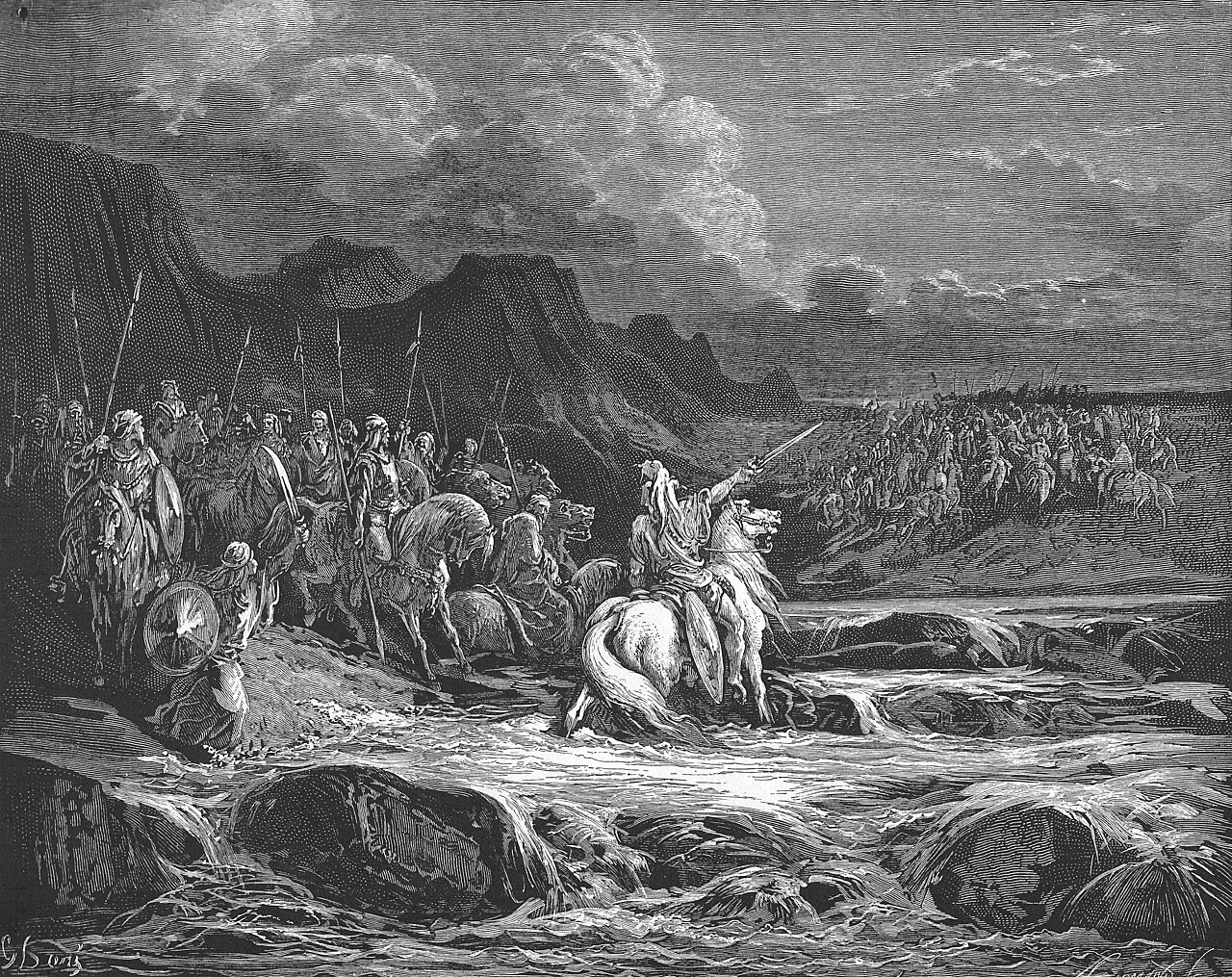
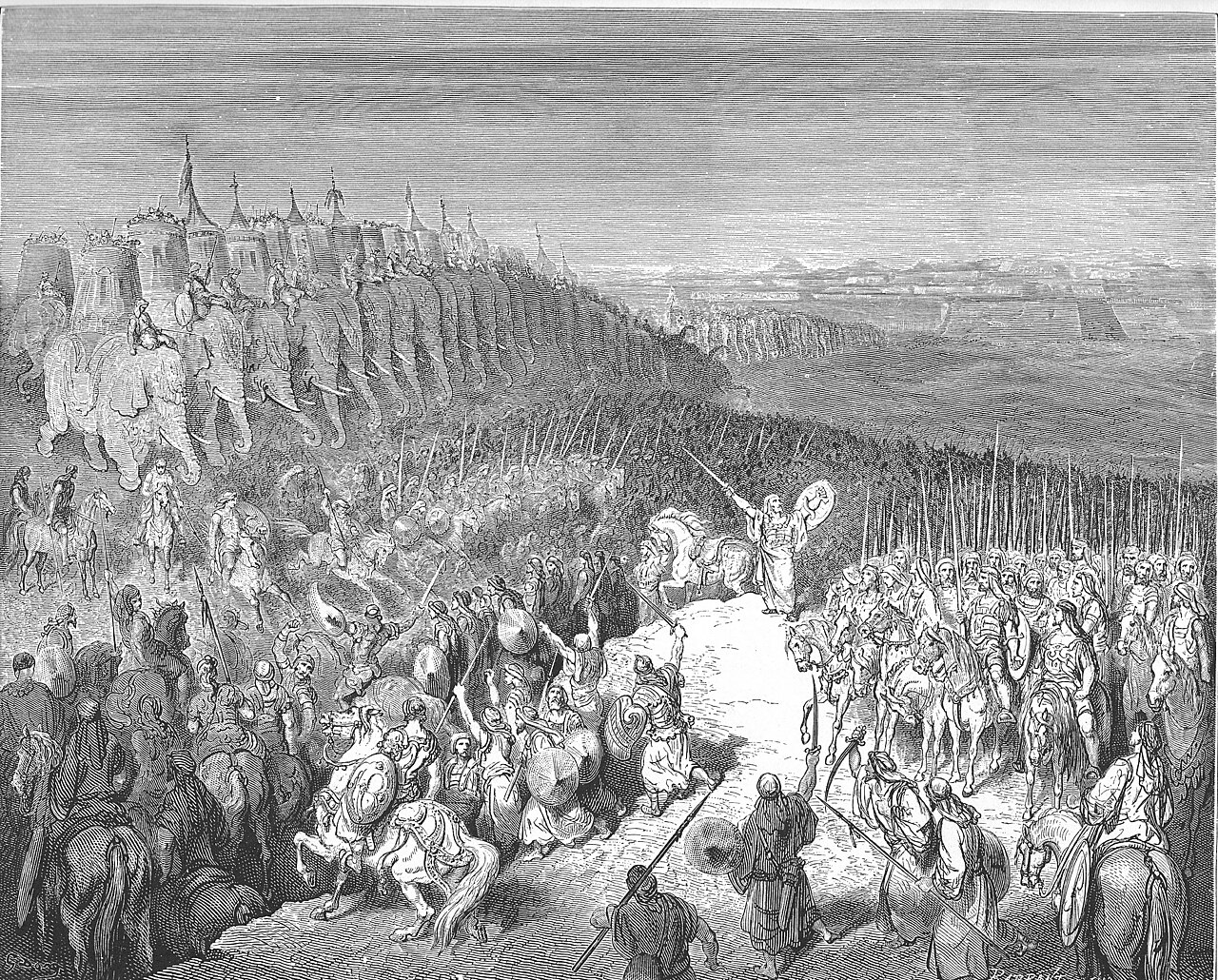
Judas Maccabaeus is significant as the central military figure of the Maccabean Revolt. Mindful of the superiority of Seleucid forces, Judah's strategy was to avoid engagement with their regular army and resort to guerrilla warfare. This strategy enabled him to win a string of victories. At the battle of Nahal el-Haramiah, he defeated a small Seleucid force under Apollonius, governor of Samaria, who was killed. Judah took possession of Apollonius's sword and used it until his death as a symbol of vengeance. Shortly after, he routed a larger Seleucid army under Seron near Beth-Horon. Then, at the Battle of Emmaus, he defeated forces led by generals Nicanor and Gorgias. By a forced night march, Judah eluded Gorgias and attacked the Seleucid camp, taking them by surprise. The defeat at Emmaus convinced Lysias that he must prepare for a serious war. After several years of conflict, Judah drove out his foes from Jerusalem, except for the garrison in the citadel of Acra. He purified the defiled Temple of Jerusalem and, on the 25th of Kislev (December 14, 164 BCE), restored the service in the Temple. The reconsecration of the Temple became a permanent Jewish holiday, Hanukkah, which is still celebrated annually. Later, Judah aided Jewish communities in Gilead, Transjordan, and Galilee. He captured and destroyed Hebron and Maresha, and marched on the coast, destroying altars and statues of pagan gods in Azotus. Internal conflict with the Hellenist party and renewed Seleucid attacks marked his final years. In the Battle of Elasa, Judah and those who remained faithful to him were killed. His body was taken by his brothers from the battlefield and buried in the family sepulcher at Modiin.
Did You Know?
- Judah was the third son of Mattathias the Hasmonean, a Jewish priest from the village of Modi'in.
- The name Maccabee may derive from the Aramaic maqqaba, meaning 'hammer' or 'sledgehammer', in recognition of his ferocity in battle.
- At the battle of Nahal el-Haramiah, Judah defeated a Seleucid force under Apollonius, governor of Samaria, and took possession of Apollonius's sword, using it until his death as a symbol of vengeance.
- The reconsecration of the Temple on the 25th of Kislev (December 14, 164 BCE) became the permanent Jewish holiday of Hanukkah, which is still celebrated annually.
- The Roman–Jewish Treaty was an agreement made between Judah Maccabee and the Roman Republic in 161 BC, the first recorded contract between the Jewish people and the Romans.
From Priesthood to Command
Judah Maccabee entered history as a Jewish priest, the third son of Mattathias, a fellow kohen from the small village of Modi'in. His world was one of temple service and religious observance until the Seleucid ruler Antiochus IV Epiphanes, who had issued sweeping decrees since roughly 169 or 168 BCE banning Jewish religious practices, forced his family into open rebellion. In 167 BCE, Mattathias raised the first banner of resistance, marching alongside his five sons—Judah, Eleazar, Simon, John, and Jonathan—into a war against an empire. When Mattathias fell the following year, in 166 BCE, Judah stepped into the commander's role not by popular vote or royal appointment but by his father's explicit deathbed instruction. The ancient text known as the First Book of Maccabees presents this succession as almost inevitable, crediting Judah's personal courage and natural military instinct as the qualities that made him the obvious choice to carry the revolt forward. What followed was a transformation from a priestly household into a revolutionary movement, with Judah at its helm for the final four years of the struggle.
Guerrilla Tactics and a String of Victories
Confronted by a Seleucid military machine far larger than his own force, Judah made a deliberate strategic choice in the first two years of the revolt: he refused to meet the enemy's regular army in open battle. Instead, he waged a war of harassment and ambush, striking quickly and vanishing before the Seleucids could concentrate their numbers, thereby sowing a persistent sense of insecurity throughout the occupied territories. This approach paid off spectacularly. At Nahal el-Haramiah, he killed Apollonius, the Seleucid governor of Samaria, and seized the man's sword, which he carried for the rest of his life as a personal emblem of vengeance. Word of that victory drew new recruits to the Jewish cause in droves. Near Beth-Horon, Judah exploited superior terrain to rout a larger force under the general Seron. His most audacious early triumph came at Emmaus, where he executed a forced night march to slip past Gorgias's cavalry, then struck the Seleucid camp at dawn while the enemy slept. The defeated commander retreated to the coast, and Lysias, the viceroy left behind by Antiochus, was compelled to assemble an entirely new and larger army for a second campaign.
The Hammer: Origins of a Name
In the opening phase of the uprising, Judah acquired the byname Maccabee, and its etymology has generated centuries of debate. No scholar can say with certainty whether the word is best read as Greek, Hebrew, or Aramaic. One widely cited theory links it to the Aramaic root maqqaba, meaning hammer or sledgehammer, a martial epithet comparable to the Latin cognomen borne by the eighth-century Frankish warlord Charles Martel. Jewish tradition offers a different reading: the letters spell out the opening phrase of a verse from Exodus, 'Who is like you, O God, among the gods that are worshiped?'—a battle-cry that also appears in daily liturgical prayer. A third scholarly proposal sees the name as a contraction of maqqab-Yahu, 'the one marked or designated by God,' drawing on the Hebrew verb naqab. Though it functions in later sources almost like a family surname, Jews did not use hereditary surnames until the medieval period. In practice, Maccabee eventually came to designate not just Judah but every member of the Hasmonean family who took up arms during the revolt.
The Rededicated Temple and the Road to Independence
After years of guerrilla campaigns, Judah finally expelled the Seleucid garrisons from Jerusalem, leaving only the citadel of Acra still in enemy hands. He then turned to the most sacred task: purifying the Second Temple, which had been desecrated with statues of Greek deities. On the twenty-fifth day of Kislev, corresponding to December 14, 164 BCE, the full liturgical service was restored, and that act of reconsecration gave birth to Hanukkah, the festival of Dedication. The holiday has endured for more than two millennia, surviving even the Temple's destruction in 70 CE, and is still observed every winter. The liberation of Jerusalem marked the first concrete step toward Jewish political independence. Yet Judah's campaigns did not stop there. He dispatched his brother Simeon with three thousand men to defend the Jewish communities of Galilee, personally led Jonathan into Transjordan to rescue besieged populations in Gilead, marched south to capture and raze the Edomite cities of Hebron and Maresha, and destroyed pagan altars along the Mediterranean coast at Azotus. Each victory expanded the territory under Hasmonean control and deepened the resolve of a people reclaiming their homeland.
Gallery
Frequently Asked Questions
Who is Judas Maccabeus?
Judas Maccabeus, also called Judah Maccabee, was a Jewish priest and the third son of Mattathias. He rose to become the chief military commander of the Maccabean Revolt against Seleucid rule in the mid-second century BCE.
What was Judas Maccabeus's role in the Maccabean Revolt?
After his father Mattathias died around 166 BCE, Judas assumed command of the Jewish uprising against the Seleucid Empire. He led the revolt's military efforts until his death in 160 BCE, overseeing the campaign that ultimately recovered Jerusalem.
How does Judas Maccabeus's story end?
Judas Maccabeus died in 160 BCE while still at the head of the Hasmonean struggle, leaving the revolt unfinished in his own hands. Leadership of the remaining campaign passed to his brothers.
Why is Judas Maccabeus connected to Hanukkah?
Hanukkah marks the 164 BCE purification and rededication of the Second Temple, a task Judas carried out by removing statues of Greek deities and restoring Jewish worship. His actions during that event form the historical foundation of the holiday.
What was Judas Maccabeus's background before the revolt?
He was the third son of the priest Mattathias, which gave him a kohen (priestly) lineage. That religious standing, combined with his family's opposition to Seleucid policies, positioned him to assume both spiritual and military leadership of the uprising.
More in Ancient & Medieval Military Leaders 1-24
Elsewhere in the Ancient & Medieval Military Leaders universe
Spotted an error? Know more?
This is a living reference — every entry is fact-audited, and reader corrections feed straight into our audit queue. Suggest an edit · See this site's audit record