
Jean III de Grailly
Gascon nobleman and military leader in the Hundred Years' War.

Heralder · CC BY-SA 3.0
Jean III de Grailly, also known as John de Grailly, was a Gascon nobleman and military leader in the Hundred Years' War.
Lore & Background
Jean III de Grailly was the son of Jean II de Grailly, Captal de Buch, Vicomte de Benauges, and of Blanch de Foix, a cousin of the counts of Foix. After release the following year, he remained loyal to the English. While attempting to lift the siege of Soubise, his force was surprised by a French force led by Owain Lawgoch, and he was captured. Jean de Grailly remained a prisoner of the French for the rest of his life at the Temple in Paris, because Charles V believed him too dangerous to ransom. He refused freedom if it meant taking up arms against the king of England.
Reader's Guide
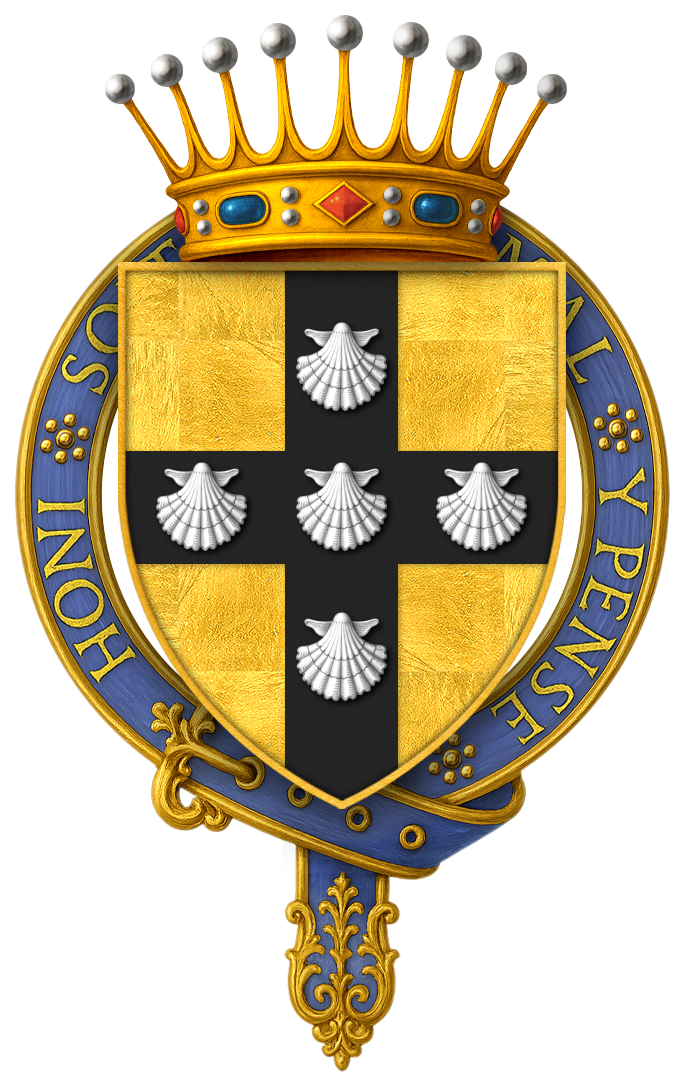
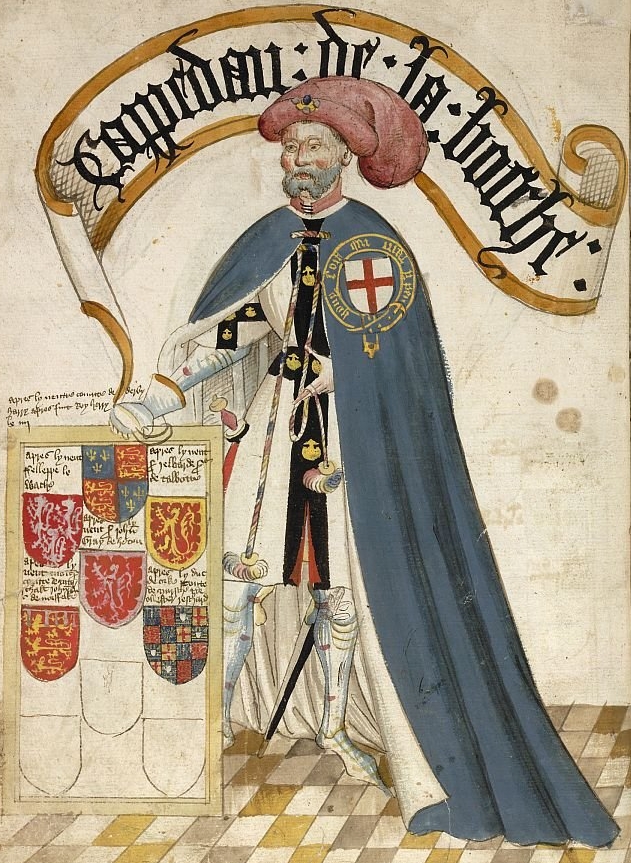
Jean III de Grailly's significance lies in his role as a key military commander for the English during the Hundred Years' War, particularly his flanking maneuver at the Battle of Poitiers that led to the capture of the French king. His career illustrates the shifting loyalties of Gascon nobles in the conflict, as he defected to the French side briefly before returning to English allegiance. His capture and imprisonment without ransom, due to Charles V's fear of his military skill, underscore his perceived importance. His death, reportedly from refusing food after learning of the Black Prince's death, highlights the personal bonds of chivalric loyalty celebrated by Froissart. As a founder Knight of the Garter and Constable of Aquitaine, he represents the highest honors of the English chivalric order and administration in Gascony. His legacy passed to his uncle, Archambaud, Count of Foix, and his descendants.
The Chivalric Code as Way of Life
The chivalric code that shaped the world of a medieval knight like Jean III de Grailly was far more than a military manual. By the Late Middle Ages, it had crystallized into a comprehensive moral system weaving together three distinct threads: the warrior ethos of the battlefield, the devotional piety expected of a Christian gentleman, and the refined courtly manners demanded by aristocratic society. These elements combined to produce a singular notion of honour and nobility governing how a chevalier conducted himself in every sphere of life. The code traced its deepest roots to the Carolingian Empire, where the idealized cavalryman—trained individually, brave in combat, and devoted to service—set the template for generations of mounted warriors in Francia. Over the centuries, the emphasis broadened from purely martial virtue to encompass general social and moral obligations, transforming a practical military identity into something approaching a full philosophy of life.
Literary Foundations and the Matter of France
The ideals that defined knighthood in the medieval period were not merely lived but also narrated, and the literary cycles carrying them forward shaped public understanding of what a knight ought to be. The Matter of France, with its legendary paladins serving Charlemagne and his men-at-arms, offered a model of martial devotion and collective loyalty. The Matter of Britain, drawing on Geoffrey of Monmouth's Historia Regum Britanniae from the 1130s, introduced the Arthurian Round Table and its associated codes of fellowship and honour. These narratives, flourishing between roughly 1170 and 1220 in France, gave the chivalric language its most vivid expression. Three texts—Ordene de chevalerie, Ramon Llull's Libre del ordre de cavayleria, and Geoffroi de Charny's Livre de Chevalerie—each attempted to codify the qualities of knighthood, though none of their authors knew the others' work. Together they sketch a vision in which military service, noble birth, and religious faith are inseparable.
The Evolution of the Knightly Ideal
The very word 'chivalry' carries the history of its transformation. Derived from the Old French chevalerie—literally 'horse soldiery'—the term originally denoted nothing more than the collective body of heavy cavalry when formed on the battlefield. A chevalier, in its earliest sense, was a man of aristocratic standing and noble ancestry who could, if summoned, equip himself with a war horse and the arms of a heavy cavalryman, having passed through certain rituals conferring his status. The English language borrowed the term as early as 1292. Yet by the twelfth century, the meaning had expanded well beyond the concrete military. The chevalier became synonymous with the Christian warrior ethos celebrated in romance literature and with the ideal of courtly love propagated in the Minnesang tradition. What began as a description of mounted soldiers in the field evolved into an abstract moral and spiritual ideal, a shift that would define how later centuries understood the knightly vocation.
Ideal versus Reality: The Historian's Challenge
A persistent temptation in chivalric history is to locate a golden age when the code was genuinely lived rather than merely imagined. Scholars such as Jean Charles Léonard de Sismondi cautioned against this romantic projection, arguing that chivalry was fundamentally an ideal world existing in the imaginations of romance writers, distinct from the real feudal system with its own virtues and vices. He noted that contemporary historians documented the corruption and ferocity of the nobility in plain detail, while poets perpetually placed the perfect knightly age further and further in the past. The famous 'Ten Commandments of Chivalry,' compiled by French literary historian Léon Gautier in his 1884 work La Chevalerie, are often cited as a medieval list, but no such document actually existed. Gautier abstracted his moral bullet points from broad reading of twelfth- and thirteenth-century romances. The chivalric code, in other words, was a product of the Late Middle Ages, shaped by post-crusade idealization and the literary tradition of courtly love rather than by any single authoritative text.
Gallery
Frequently Asked Questions
Who is Jean III de Grailly?
He was a Gascon nobleman and military commander active during the Hundred Years' War, widely recognized by his title Captal de Buch. The chronicler Jean Froissart held him up as a model of knightly virtue in his accounts of the period.
Why is Jean III de Grailly remembered in chivalric tradition?
Froissart specifically praised him as an ideal of chivalry, highlighting both his battlefield competence and his adherence to knightly courtesy. That combination of martial skill and personal honor kept his name prominent in medieval military memory.
More in Ancient & Medieval Military Leaders 1-24
Elsewhere in the Ancient & Medieval Military Leaders universe
Spotted an error? Know more?
This is a living reference — every entry is fact-audited, and reader corrections feed straight into our audit queue. Suggest an edit · See this site's audit record