
Jiang Ziya
First ruler of Qi and Zhou dynasty strategist.

Unknown author · Public domain
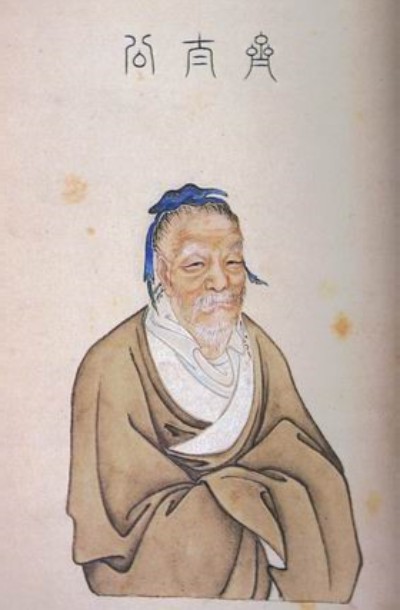
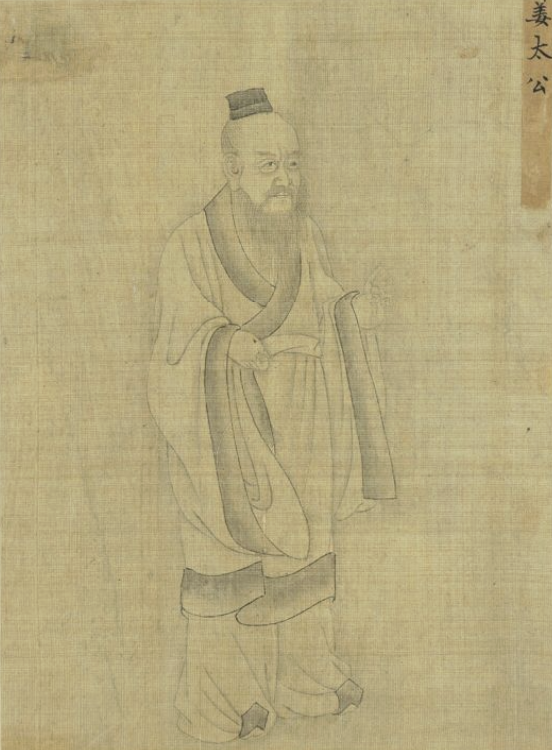
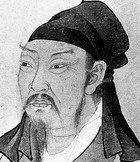
Jiang Ziya (fl. 12th century BC – 11th century BC), also known as Jiang Shang, Lü Wang, and by several other names, was the first ruler enfeoffed with the Qi state under the Zhou dynasty. He was a military general and strategist who assisted King Wen of Zhou and King Wu of Zhou in overthrowing the Shang dynasty and establishing the Zhou dynasty. Following the Zhou victory at the Battle of Muye, he served as a Zhou minister and was later enfeoffed with the land of Qi, establishing his seat at Yingqiu (modern-day Linzi, Zibo, Shandong). He was deified as a war god primarily from the Tang dynasty onward, and is a main hero in the Ming-era novel *Investiture of the Gods*.
- known_for
- First ruler of Qi, strategist in Zhou conquest of Shang, author of Six Secret Te
Lore & Background
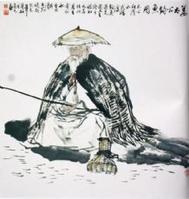
Jiang Ziya's early life is shrouded in legend, but early canonical sources like the *Records of the Grand Historian* do not record the later folkloric tale that he was abandoned in the wild as an infant and raised by animals. Instead, he is known to have served the Shang court before leaving due to its corruption. A popular but unverifiable legend claims he feigned madness to escape King Zhou of Shang and disappeared, resurfacing at an advanced age—often said to be seventy-two—in the Zhou countryside, where he fished with a barbless hook on a tributary of the Wei River.
Reader's Guide
Jiang Ziya's significance lies in his role as the architect of the Zhou dynasty's military and political success. He advised King Wen and King Wu, leading the Zhou forces at the Battle of Muye, where the Shang capital was taken and King Zhou perished. After the rebellion of the Three Guards, he was enfeoffed with Qi, which thrived under his rule through improved communications and use of fish and salt resources. In the Tang dynasty, he was given his own state temple as the martial patron, achieving official status approaching that of Confucius. His legacy also endures in Chinese literature, particularly the Ming-era novel *Investiture of the Gods*, which popularized the names Jiang Shang and Jiang Ziya. His philosophy that a country becomes powerful only when the people prosper, with reduced taxes and corvée labor, influenced Zhou governance.
Did You Know?
- Jiang Ziya led an army of 45,000 men and 300 chariots at the Battle of Muye, where the Shang capital was taken and King Zhou perished.
- He was enfeoffed with the land of Qi after the rebellion of the Three Guards, establishing his seat at Yingqiu (modern-day Linzi, Zibo, Shandong).
- In the Tang dynasty, he was given his own state temple as the martial patron, achieving official status approaching that of Confucius.
- His teachings to King Wen and King Wu are recorded in the *Six Secret Teachings*, one of the Seven Military Classics of Ancient China.
- A popular legend claims he fished with a barbless hook on a tributary of the Wei River before being appointed prime minister by King Wen of Zhou.
The Decisive Crossing
Around 1046 BC, Jiang Ziya stood alongside King Wu at the head of a combined force of forty-five thousand soldiers and three hundred chariots. Together they pushed their army across the Yellow River, a move that set the stage for the confrontation at Muye. There, the Shang ruler Di Xin was defeated, and with that single engagement the Zhou dynasty was born. The campaign was the culmination of a lineage of struggle: King Wen, Wu's father, had earlier secured his freedom from Shang imprisonment and relocated the Zhou seat of power to Feng, in what is now Xi'an. His father before him, Jili, had been a warrior who subdued several Xirong tribal groups before meeting a treacherous end at Shang hands. Jiang Ziya's role in that final, decisive battle placed him at the center of a generational arc of resistance that finally toppled the Shang house and inaugurated what would become the longest-reigning dynasty in Chinese history.
Ally at the Threshold of a New Order
Jiang Ziya is described in the founding narrative not as a king or a hereditary lord but as an ally to King Wu, the son of King Wen. This distinction matters because the Zhou succession had been shaped by earlier choices: the duke had passed over his two elder sons, Taibo and Zhongyong, in favor of the younger Jili, a warrior of his own making. Taibo and Zhongyong had already departed for the Yangtze delta, where they founded the state of Wu among the local tribes. By the time Jiang Ziya joined forces with Wu, the Zhou political base was centered on the Wei River valley and the North China Plain, and the royal house bore the surname Ji. The alliance between Jiang Ziya and the Ji line at Muye thus represented a convergence of military leadership and dynastic ambition that converted a regional power into a suzerain over a far wider territory.
The Architecture of a Seven-Century State
The victory at Muye did not merely change a ruling house; it set in motion a political architecture that endured for roughly seven hundred and ninety years, from approximately 1046 BC until 256 BC, making it the longest continuous dynasty in Chinese history. In the aftermath, the Zhou enfeoffed a member of the defeated Shang royal family as Duke of Song, a practice known as Er Wang San Ke, which allowed Shang descendants to retain a ceremonial role. The Duke of Zhou, acting as regent for the young King Cheng, further codified authority through the fengjian system, a decentralized network of regional dynasties tied to the royal house by kinship. He also articulated the doctrine of the Mandate of Heaven to address the legitimacy crisis that followed the conquest. Jiang Ziya's role in making that conquest possible meant his name is inseparable from the founding of this entire institutional framework.
A Cultural Zenith Inaugurated
The era that Jiang Ziya helped open with the fall of Di Xin is widely regarded as a high point for Chinese material and intellectual culture. The Zhou period is frequently cited as the zenith of Chinese bronzeware craftsmanship, and the dynasty's span witnessed the evolution of written Chinese from oracle bone and bronze scripts into seal script, with an immature form of clerical script emerging by the dynasty's close. In the later Eastern Zhou, three of the most consequential Chinese philosophical traditions—Confucianism, Taoism, and Legalism—came into being. The Zhou themselves had emulated Shang cultural practices, possibly to legitimize their rule, and scholars note that the Zhou language was largely similar in vocabulary and syntax to that of the Shang. In this sense, the conquest that Jiang Ziya helped lead did not sever a cultural thread so much as redirect it, setting the stage for centuries of artistic and philosophical development that defined Chinese civilization.
Gallery
Frequently Asked Questions
Who is Jiang Ziya?
Jiang Ziya (also called Jiang Shang or Lü Wang) was a military strategist and general active in the late 12th to early 11th century BC. He is best recognized as the first enfeoffed ruler of the Qi state under the Zhou dynasty.
What was Jiang Ziya's role in overthrowing the Shang dynasty?
He served as a key strategist and military leader for King Wen and King Wu of Zhou, helping plan and execute the campaign that culminated in the Battle of Muye. His tactical contributions were central to the Zhou victory that ended Shang rule.
What is the Six Secret Teachings and how does it connect to Jiang Ziya?
The Six Secret Teachings is a military strategy text traditionally attributed to Jiang Ziya. It is one of the works that cemented his reputation as a foundational figure in Chinese military thought.
What happened to Jiang Ziya after the Zhou victory at Muye?
Following the battle, he was appointed as a Zhou minister and then enfeoffed with the territory of Qi, establishing his capital at Yingqiu in what is now Shandong province. This made him the founding ruler of the Qi state.
Why is Jiang Ziya considered important in Chinese history?
Beyond his political and military achievements, he was later deified as a war god beginning in the Tang dynasty. His legacy spans state-building, military strategy, and religious veneration, making him one of the most enduring figures in Chinese tradition.
More in Ancient & Medieval Military Leaders 1-24
Elsewhere in the Ancient & Medieval Military Leaders universe
Spotted an error? Know more?
This is a living reference — every entry is fact-audited, and reader corrections feed straight into our audit queue. Suggest an edit · See this site's audit record